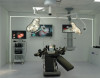
In the operating room, there is a piece of equipment that may seem ordinary but is crucial to the success of a surgery—the surgical light. Perhaps your first thought is, “Isn’t a light just for illumination?” But for doctors, it is more than just an ordinary light; it is a “third eye” that allows them to see blood vessels down to the millimeter level and perform precise procedures.
I. From Relying on the Weather to Solving the Problem of “Sufficient Brightness”
In 19th-century operating rooms, surgeons were entirely at the mercy of the weather: on sunny days, they relied on natural light, while on cloudy days they used candles or kerosene lamps—light that fluctuated between bright and dim and was riddled with shadows. Back then, surgeons not only had to battle disease but also contend with poor visibility—shadows obscured details of the wound, and excessive heat caused the patient’s tissues to dry out.
In 1919, French professor Véran created the world’s first surgical shadowless lamp, achieving a “shadowless” effect in the surgical field for the first time. Over the next two to three decades, shadowless lamps began moving from laboratories into actual operating rooms. By the 1960s, halogen lamps had become mainstream, with brightness comparable to midday sunlight in the Mediterranean.
As the global shadowless surgical lamp industry evolved from its infancy through a phase of fundamental innovation centered on illuminance, Weyuan Medical delved deeply into this field, keeping pace with the industry’s first wave of technological iterations and focusing on the essential need for basic illumination. aligning with international first-generation surgical light standards. In 2004, the company established a surgical light R&D team and began manufacturing perforated surgical lights (halogen lamps) on a contract basis for the Shanghai Medical Group, achieving an annual output value of 2 million. This addressed the industry’s fundamental pain points—dim lighting and excessive shadows—and laid a solid technical foundation for subsequent refined product upgrades.
At present, the only function-driven criteria for evaluating the quality of a surgical light are illuminance (lux) and shadow area.
II. From Solving the Problem of “Sufficient Brightness” to Pursuing “Ease of Use”
In the 1990s, halogen lamps—which had been designed with an excessive focus on brightness—became a new source of problems: the intense light of 200,000 lux (equivalent to twice the brightness of midday summer sunlight) caused eye strain for surgeons; the lamp bodies generated heat that scorched surgeons’ heads and surgical sites; they were bulky and difficult to adjust; and they caused color distortion (making it hard to distinguish between arteries and veins).
In 1972, China’s surgical lights were upgraded from a heavyweight counterbalance mechanism to a spring-balanced system, enabling more flexible positioning of the boom arm.
In 1975, Shanghai manufactured China’s first cold-light single-port surgical light, which significantly reduced the lamp’s temperature, eliminating the “scorching” sensation on the surgeon’s head and markedly improving tolerance during prolonged surgeries.
In the early 21st century, the widespread adoption of LED light sources truly resolved issues related to color temperature correction and color rendering index, while also offering adjustable color temperatures. Surgeons can now select the optimal spectrum based on different tissue types, making the layered structure of blood vessels, nerves, and fascia clearly visible at a glance.
Along with the localization and innovation of domestic surgical light technology and the widespread adoption of LED light sources, Weyuan Medical precisely identified pain points in clinical use, eliminated the drawbacks of traditional halogen lighting equipment, and took the lead in completing a full-line product upgrade. In 2011, the company successfully launched the WYLED200 series of LED examination lights and the “Starlight” WYLED700/500 series of surgical lights. Leveraging a mature spring-balanced cantilever structure, low-temperature cold light technology, and high-precision LED color rendering index, the company overcame industry challenges such as overheating lamp bodies, color distortion, and positioning difficulties. This makes the equipment suitable for extended surgical procedures and fully meets the core clinical requirements of being “practical and easy to use.”
Today, the criteria for evaluating the quality of a surgical light are color rendering index, temperature control, and convenience.
III. From Pursuing “Ease of Use” to Ensuring “Health”
During prolonged surgeries, the high blue-light content in LEDs can damage surgeons’ retinas; high-frequency flickering causes eye strain; and uneven light distribution leads to errors in judgment.
Starting around the 2010s, blue-light-safe LEDs became the industry standard. Subsequently, international standards (such as IEC 62471) and domestic standards (GB/T 39771.1-2021) clearly defined the photobiological safety requirements for surgical lights, driving “blue-light safety” to become a standard feature of these products.
Around the 2010s, flicker-free high-frequency drive technology matured, enabling “flicker-free” or “imperceptible flicker” operation.
From the late 2000s to the early 2010s, the concept of uniform light spots (light spot gradient control) was introduced, and the Chinese medical industry standard YY0627-2008 (and subsequent versions) explicitly required light spot uniformity metrics.
At a critical stage when the industry was focusing on healthcare professionals’ occupational health and upgrading photobiological safety standards, Weiyuan Medical aligned with IEC international standards, national GB/T standards, and medical industry YY standards to comprehensively optimize the core light source configurations of its products. In 2014, the company launched the WYLED3/5 series of surgical lights, equipped with a flicker-free high-frequency drive system that ensures uniform light coverage across the entire field. By addressing these issues at the light source level, the system helps prevent visual fatigue and visual judgment errors among physicians, thereby integrating occupational health protection for medical staff into the core R&D standards of the product.
Today, the standard for evaluating the quality of surgical lights is driven by occupational health considerations.
IV. From Ensuring “Health” to Achieving “Safety”
To meet the advanced safety requirements for sterile protection in modern operating rooms, the stable operation of equipment, and the advanced safety requirements for multi-device compatibility, Weyuan Medical has comprehensively upgraded the configurations of its entire line of high-end surgical lights. In 2023, the company launched the first-generation WYLED650 surgical light series, featuring a sealed, streamlined, antimicrobial housing and a sterile, disinfectable handle. It is designed to work in coordination with a full suite of medical equipment—including surgical navigation systems and microscopes—thereby achieving an upgrade from a single lighting device to a comprehensive safety solution for the operating room.
Today, the standard for evaluating the quality of a surgical light is its role as a smart terminal integrated into the overall operating room system.
V. From Achieving “Safety” to Transcending “Intelligence”
Traditional surgical lights require doctors to manually adjust the angle, power, and brightness. Each instance of “light adjustment” and the constant “shadow management” consumes mental energy that should be devoted to surgical decision-making. Traditional high color rendering indices can only ensure “color accuracy,” but they cannot make specific tissues “stand out” from the background. In the operating room, equipment such as surgical lights, navigation systems, microscopes, and endoscopes operate independently, yet they interfere with one another electromagnetically, spectrally, and spatially.
A conceptual study published in 2019 introduced the concept of a deformable light field, enabling the spot shape and light distribution to adapt in real time to wounds of varying shapes, thereby overcoming the limitations of traditional “fixed circular light spots.”
From 2020 to 2025, new surgical lights adopted multi-color LED adjustable spectra, tailored to specific clinical scenarios, resulting in significantly improved resolution.
The emergence of a dual-robotic-arm surgical light system in 2024 enabled lighting to dynamically track surgical instruments and the operative field. Based on predetermined illuminance functions and human visual comfort thresholds (brightness, color temperature), the system can automatically optimize and identify the best angle adjustment and lighting parameter configurations, achieving truly personalized adaptive lighting.
In 2025, the SmartOT project was officially unveiled. Featuring 56 independently controllable lighting modules and multiple depth sensors installed on the ceiling, the system continuously monitors the positions of surgeons and surgical instruments within the operating room. Upon detecting any object that might cast a shadow, it automatically activates or deactivates the corresponding modules to proactively eliminate shadows.
From 2025 to 2026, a unidirectional suction and cooling system fundamentally eliminates the possibility of the lamp’s interior contaminating the operating room environment. Modern high-end surgical lights begin to integrate high-definition cameras and wireless transmission modules, supporting real-time surgical recording, remote consultations, and live educational broadcasts. Building on the “mechanical registration” with navigation systems from the previous phase, this new phase further evolves into spectral registration.
Keeping pace with global trends toward intelligent, scenario-based, and integrated surgical lights, Weyuan Medical has deeply engaged in the smart operating room lighting sector. The integrated operating room solution launched in 2025 was the first in the industry to achieve top-tier performance across three dimensions: shadow compensation, measured Ra and R9 values, and the ability to adjust illuminance, color temperature, and light spot size without altering the light pattern. By seamlessly integrating surgical recording, remote consultations, live educational broadcasts, and transforming the surgical headlight from a passive lighting tool into an intelligent surgical partner that assists in procedures, reduces the burden on medical staff, and empowers smart healthcare.
Today, the standard for evaluating a surgical headlight is whether it serves as an “active, helpful, intelligent partner.